


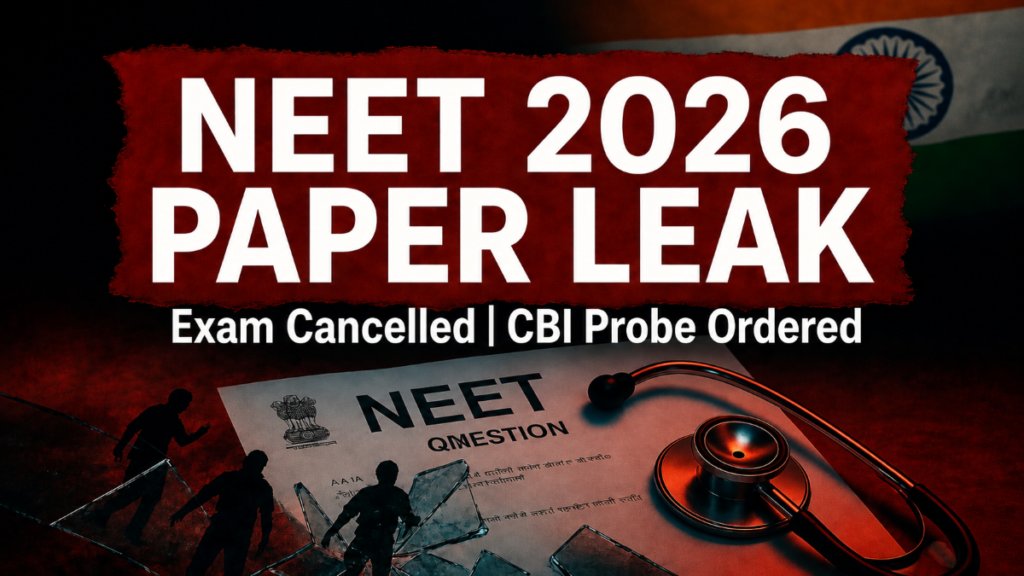
The dreams of lakhs of aspiring doctors lie shattered once again. The National Eligibility cum Entrance Test (NEET-UG) 2026, conducted on May 3, 2026, has been cancelled by the National Testing Agency (NTA) following confirmed allegations of a paper leak. This marks yet another chapter in the ongoing crisis of trust in India’s premier medical entrance examination.
What is NEET?
NEET (National Eligibility cum Entrance Test – Undergraduate) is India’s single largest national-level entrance examination for admission to undergraduate medical courses like MBBS, BDS, and AYUSH programs (BAMS, BUMS, BHMS, etc.) in government and private colleges across the country. It tests students in Physics, Chemistry, Botany, and Zoology.
Formerly known as the All India Pre-Medical Test (AIPMT), NEET was introduced to standardize admissions and replace multiple state-level exams. It is mandatory for medical admissions under the National Medical Commission (NMC) Act. Every year, over 20-24 lakh students appear for the exam, competing for around 1 lakh+ seats.
National Testing Agency(NTA)
The National Testing Agency (NTA) is an autonomous, self-sustained organization under the Ministry of Education, Government of India. It was established in November 2017 to conduct efficient, transparent, and standardized entrance examinations for higher education institutions, including NEET-UG, JEE Main, CUET, and others.
The agency was created to bring professionalism and technology-driven processes to India’s examination system, modelled partly after global bodies like the ETS in the US. However, repeated controversies have raised serious questions about its effectiveness and security protocols.
History of Leaks in NTA-Conducted Exams
NTA exams have faced multiple leaks and irregularity allegations since their inception:
- JEE Main 2021: Paper leak and impersonation scandals.
- NEET-UG 2024: Significant controversy over leaks reported from Bihar and Jharkhand; CBI probe confirmed a racket in which candidates paid ₹30-50 lakh. At least 155 students directly benefited, leading to arrests, admissions cancellations, and suspensions.
- Other incidents include UGC-NET, CSIR-NET, and various state exams.
Analyses suggest dozens of major paper leaks or irregularities across India since 2019, with NTA exams frequently under scrutiny.
The 2026 NEET Paper Leak
The 2026 leak reportedly involved a “guess paper” or question set circulated via WhatsApp and Telegram channels hours or days before the exam. Investigations traced the leak to a network spanning states such as Maharashtra (Nashik),Rajasthan and Other States. A PDF matching a significant number of actual questions (reports mention around 120 questions) was in circulation.
Police arrested suspects, including individuals who bought and resold the paper. The case has been handed over to the CBI for a comprehensive probe into a multi-state racket reportedly involving 45+ people. Partially burnt papers, matching serial numbers, and confessions from arrested candidates confirmed the breach.
The scale prompted the NTA to cancel the entire exam suo motu — a rare move — and announce a re-test on dates to be notified later (no fresh fees or registrations required).
How Many Students Suffered?
- Over 23 lakh candidates registered and appeared for the exam across 551+ cities.
- Many students had prepared for years, with some selling assets or travelling long distances. The cancellation forces everyone to restart the process.
- While the leak may have directly benefited a few hundred (exact numbers under investigation), the psychological and logistical impact affects millions. Honest candidates bear the brunt of systemic failures.
In the 2024 case, actions included the cancellation of 14 admissions, the suspension of 26 students, and the debarment of others. Similar measures are expected now.
NTA’s Statement
NTA has acknowledged the breach and cancelled the exam. In previous instances (like 2024), it initially denied widespread leaks, emphasizing that every question paper was accounted for and protocols were followed. For 2026, the agency has committed to a retest and to issuing refunds. Director General statements stress that culprits will not walk free and that security will be overhauled.
Union Education Minister’s Comment
Union Education Minister Dharmendra Pradhan has largely remained silent and avoided direct media questions about the latest controversy, drawing criticism from opposition parties and students who are demanding accountability and a judicial inquiry.
Conclusion
The repeated leaks expose deep flaws in logistics, storage, distribution, and digital security. Students, parents, and educators demand structural reforms: better cybersecurity, foolproof paper handling, stricter penalties under the Public Examinations (Prevention of Unfair Means) Act, and perhaps decentralization or independent oversight.
As the re-test date approaches, the focus must shift to restoring faith. For now, the aspirations of another batch of young Indians hang in uncertainty. The medical dream feels more distant than ever.