


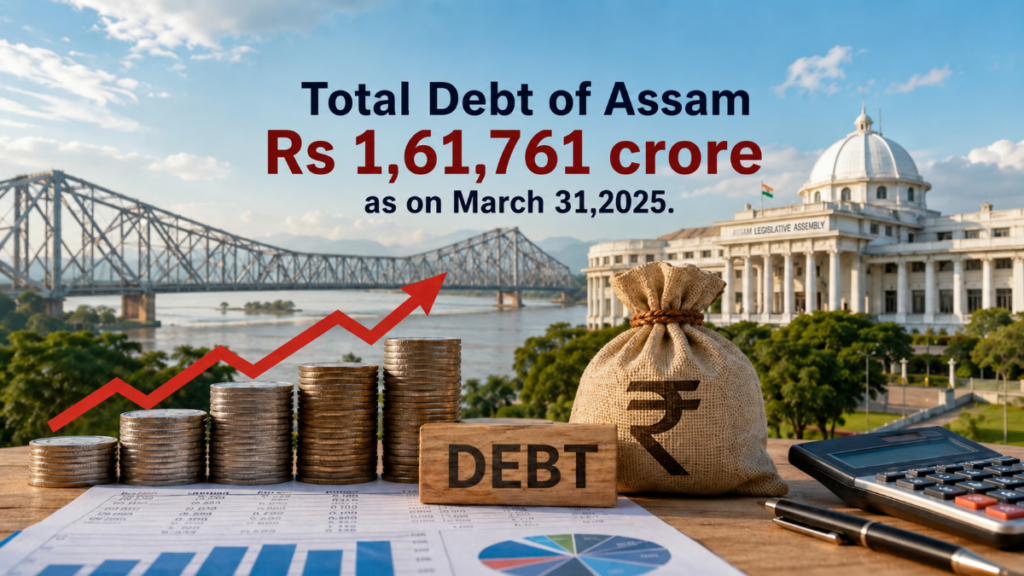
“Assam’s debt rose 4.5 times to ₹1.62 lakh crore in the last 10 years.”
This headline, reported from the Assam Assembly on 15 July 2026, has reignited debate over the fiscal health of one of Northeast India’s fastest-growing states.
According to Finance Minister Jayanta Mallabaruah’s, Assam’s outstanding debt increased from around ₹35,690 crore in March 2016 to about ₹1.62 lakh crore by March 2025. The state also paid ₹9,467.75 crore as interest in FY 2024-25 alone, highlighting the growing burden of debt servicing.
Assam’s Debt: A Decade in Numbers
Outstanding Debt Growth
| Financial Year | Outstanding Debt (Approx.) |
|---|---|
| 2015-16 | ₹35,690 crore |
| 2016-17 | ₹42,000 crore |
| 2017-18 | ₹50,000 crore |
| 2018-19 | ₹63,000 crore |
| 2019-20 | ₹72,000 crore |
| 2020-21 | ₹86,000 crore |
| 2021-22 | ₹1.02 lakh crore |
| 2022-23 | ₹1.19 lakh crore |
| 2023-24 | ₹1.40 lakh crore |
| 2024-25 | ₹1.62 lakh crore |
The debt has therefore increased by over ₹1.26 lakh crore within a decade, representing growth of more than 350%.
Why Has Assam’s Debt Increased So Sharply?
1. Massive Infrastructure Push
Over the last decade, Assam has witnessed unprecedented infrastructure spending:
- New bridges over the Brahmaputra
- Medical colleges in several districts
- Airport expansion projects
- Urban infrastructure and water supply schemes
- Semiconductor and industrial infrastructure initiatives
Large capital expenditure often requires states to borrow heavily.
According to Assam Budget documents, capital expenditure increased significantly after FY2020, becoming one of the highest among Northeastern states.
2. COVID-19 Borrowings
The pandemic severely affected state revenues.
GST collections, excise receipts and economic activities slowed considerably during FY2020 and FY2021. The Union Government also permitted states to borrow additional amounts under special windows to support pandemic-related expenditure.
This accelerated Assam’s debt accumulation.
3. Rising Social Sector Spending
Major expenditure heads include:
- Orunodoi welfare scheme
- Education spending
- Health infrastructure
- Subsidies and pensions
- Government salaries and pensions
As welfare commitments increase, states often rely on borrowings to bridge fiscal deficits.
Interest Burden Is Becoming Significant
The Assembly was informed that Assam paid:
Interest Payment in FY2024-25:
₹9,467.75 crore
This means:
- Around ₹26 crore every day
- More than ₹1 crore every hour
The minister also stated that, of the total liabilities, approximately ₹18,582 crore comprised interest-free 50-year loans, mostly provided by the Union Government.
Excluding these loans, interest-bearing debt reportedly stands at approximately ₹1.43 lakh crore.
Debt Servicing Trend
Approximate annual interest payments based on budget documents:
| Year | Interest Payments |
|---|---|
| 2016-17 | ₹2,700 crore |
| 2017-18 | ₹3,000 crore |
| 2018-19 | ₹3,400 crore |
| 2019-20 | ₹4,000 crore |
| 2020-21 | ₹4,800 crore |
| 2021-22 | ₹5,900 crore |
| 2022-23 | ₹6,800 crore |
| 2023-24 | ₹8,000 crore |
| 2024-25 | ₹9,467.75 crore |
The increase in interest payments is particularly significant because money spent on debt servicing cannot be used for development expenditure.
Conclusion
Assam’s outstanding debt has increased from around ₹35,690 crore in 2016 to nearly ₹1.62 lakh crore by March 2025, making it one of the sharpest increases among northeastern states.
Yet, rising debt alone does not imply fiscal crisis. Much depends on how borrowed funds are deployed and whether they generate long-term economic growth.
The state’s growing interest bill—nearly ₹9,500 crore annually—is perhaps the more important indicator to watch in the coming years.
If infrastructure investments boost productivity, industrialization and tax revenues, Assam’s borrowing may prove beneficial. If not, the state could face increasing fiscal pressure.