


Introduction
The Central Board of Secondary Education (CBSE), India’s largest school examination authority, faced one of its biggest controversies in 2026. What began as the introduction of a new digital evaluation system for Class XII answer sheets soon escalated into student complaints, allegations of security vulnerabilities, portal failures, cyberattack attempts, and political debate.
Millions of students depend on CBSE examinations for university admissions and future careers. Therefore, even minor discrepancies attracted nationwide attention.
What Changed in 2026?
For the 2026 board examinations, CBSE introduced a new Digital On-Screen Marking (OSM) system for evaluating Class XII answer books.
Under this system:
- Physical answer sheets were scanned.
- Digital copies were uploaded.
- Examiners evaluated scripts online.
- Marks were processed electronically.
CBSE stated that the objective was to improve efficiency, reduce human error, and speed up evaluation.
However, shortly after the results were announced, complaints began emerging from students across India.
Timeline of Events
February–March 2026
CBSE conducted the Class X and Class XII board examinations.
April–May 2026
The new digital evaluation system was used for assessment.
May 2026 – Results Declared
Class XII results were announced on 13 May 2026.
Soon after the declaration of results:
- Students reported unexpected score variations.
- Some claimed answer sheets were incorrectly evaluated.
- Others reported receiving incomplete or mismatched scanned copies of answer sheets.
- Several students alleged that marks did not reflect their performance.
Mid-May 2026 – Portal Problems
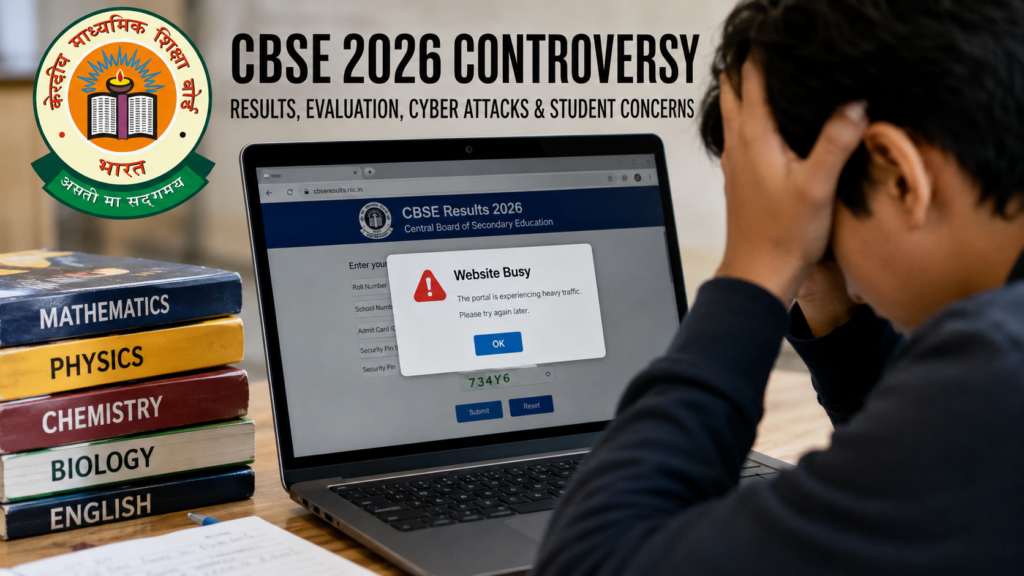
Students attempting to access answer sheets and verification services complained that CBSE portals became slow or inaccessible.
Reports suggested that the answer-sheet portal remained dysfunctional for extended periods due to heavy traffic and technical issues.
The Cybersecurity Allegations
The controversy intensified when a young cybersecurity researcher, Nisarga Adhikary, claimed to have identified vulnerabilities in the CBSE digital evaluation ecosystem.
According to media reports, the researcher alleged that:
- Sensitive answer-sheet data could be accessed.
- Security flaws existed in systems connected to digital evaluation.
- Certain vulnerabilities could potentially expose student information.
The researcher stated that he reported the issues to authorities rather than exploiting them. Reports described him as an ethical hacker or cybersecurity researcher rather than a criminal hacker.
CBSE’s Official Position
Initially, CBSE denied that the actual evaluation system had been compromised.
The Board stated that:
- The main On-Screen Marking platform remained secure.
- Claims of a breach related to testing or non-production environments.
- Student marks and evaluation records were protected.
However, later reports indicated that CBSE acknowledged certain security concerns and implemented corrective measures after the vulnerabilities were publicly highlighted.
CERT-In Warnings
A major development emerged when reports indicated that the Indian Computer Emergency Response Team (CERT-In) had warned CBSE multiple times regarding vulnerabilities in the online evaluation ecosystem.
According to reports:
- Warnings were issued in February 2026.
- Additional warnings were issued during May 2026.
- Security audits reportedly identified weaknesses that required immediate attention.
These revelations intensified scrutiny over the rollout of the digital evaluation system.
Re-Evaluation Portal Cyberattack
The controversy did not stop with result-related complaints.
In late May and early June 2026, CBSE reported that its re-evaluation portal was subject to cyberattack attempts.
Reported incidents included:
- Denial-of-Service (DoS) attacks.
- Massive traffic surges.
- Approximately 1.5 million hits generated within two minutes.
- Attempts to disrupt student access to re-evaluation services.
Despite these attacks, CBSE stated that the portal continued to function and that thousands of students successfully submitted applications.
Payment Gateway Glitches
Additional reports suggested that unauthorised attacks affected parts of the re-evaluation payment process.
Some students allegedly observed abnormal fee calculations during payment.
Government sources cited by media reports stated that around 50 students may have been affected by the incident.
Government Response
Union Education Minister Dharmendra Pradhan reviewed the situation through meetings involving CBSE officials.
The government’s position broadly included:
- Acknowledgement of certain discrepancies.
- Assurance that corrective action would be taken.
- Continued operation of re-evaluation and verification facilities.
- Efforts to strengthen portal security and address complaints.
The government maintained that student interests would be protected and that genuine grievances would be addressed.
Opposition Response
Opposition leaders and critics raised several concerns:
- Why was a large-scale digital evaluation system introduced without sufficient testing?
- Whether cybersecurity audits were completed before deployment.
- Whether warning signs were ignored.
- Whether students suffered because of administrative lapses.
Opposition voices argued that educational reforms should be implemented only after extensive pilot testing and independent security reviews.
Tender Process and Agencies Involved
CBSE uses public procurement mechanisms for examination-related services.
Available tender documents show that:
- Examination processing services are awarded through e-procurement.
- Scanning, cutting, stapling, digitization and related services are outsourced through competitive bidding.
- Technical and financial evaluations are conducted as part of the tender process.
The digital evaluation process depends on multiple vendors and technology providers working under CBSE supervision.
Some media reports have questioned aspects of the tendering process connected to digital evaluation, though no final official findings have been announced.
Is the Problem Solved?
Partially.
What Has Improved?
- Re-evaluation portals remain operational.
- Security patches have reportedly been implemented.
- CBSE continues processing verification requests.
- Government reviews are ongoing.
What Remains Unresolved?
- Student complaints regarding evaluation discrepancies.
- Questions about the digital evaluation rollout.
- Independent verification of security claims.
- Public confidence in the system.
Therefore, it would be inaccurate to say the controversy is completely over.
Is the CBSE Website Down Now?
As of the latest available information, the primary CBSE results website is accessible and displaying 2026 examination results.
However, individual portals have experienced temporary outages due to:
- Heavy traffic,
- Technical glitches,
- Cyberattack attempts,
- Maintenance activities.
Thus, while there have been intermittent disruptions, there is no evidence that the entire CBSE digital infrastructure is currently offline.
Conclusion
The CBSE 2026 controversy is one of the most significant challenges India’s education system has faced in recent years. The introduction of digital evaluation promised modernization but instead exposed concerns regarding implementation, cybersecurity preparedness, transparency, and student grievance handling.
While CBSE and the Government of India have taken corrective measures and continue to defend the integrity of the examination process, questions remain regarding security audits, vendor management, and the readiness of large-scale digital examination systems.
The coming months, including any official investigations and security reviews, will determine whether the controversy becomes a turning point for stronger educational technology governance in India.
Source: CBSE Official Website