


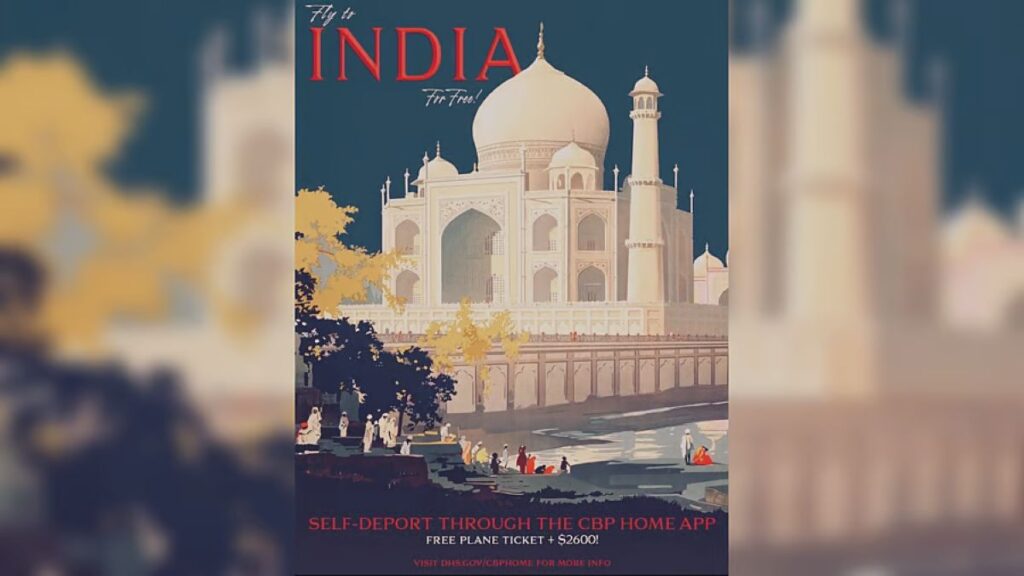
The US Department of Homeland Security (DHS) launched a fresh wave of promotions for its Project Homecoming self-deportation initiative. The program, originally rolled out in May 2025, encourages undocumented migrants to leave the United States voluntarily through the CBP Home app. In return, participants receive a free flight home and an exit bonus — recently set at $2,600 (approximately ₹2.2 lakh).
The campaign targeted multiple nationalities with tailored social media graphics. For India, the poster prominently featured the Taj Mahal, one of the world’s most iconic monuments, alongside the headline: “Fly to INDIA For Free!” The text continued: “You can go home with a fresh start! Receive a FREE flight home and a $2,600 exit bonus when you use CBP Home to self-deport: DHS.GOV/CBPHOME.”
Similar visuals used landmarks from China and Colombia, but the India-specific ad — posted around March 17–18, 2026 — quickly went viral and triggered widespread backlash.
The Program’s Pitch
DHS positions Project Homecoming as a humane, cost-saving alternative to forced removals. By self-reporting through the app, migrants can avoid detention, certain penalties (such as fines for failing to depart after a removal order), and long-term re-entry bans. The department claims the initiative has already seen significant uptake since its launch, framing it as a “fresh start” for individuals while reducing enforcement burdens on US taxpayers.
Reactions in India: From Sarcasm to Anger
The use of the Taj Mahal, a UNESCO World Heritage Site symbolizing Indian heritage, love, and national pride, was widely seen as tone-deaf and disrespectful.
- Major Indian outlets like Times of India, Deccan Herald, India Today, NDTV, and Hindustan Times covered the story within hours, describing the poster as “offensive,” an “insensitive campaign,” and disrespectful to 1.4 billion Indians.
- On social media platforms including X (formerly Twitter) and Instagram, users called it cultural insensitivity at best and a thinly veiled “get out” message at worst. Comments ranged from sarcastic quips like “Taj Mahal trap?” to accusations of trivializing migration struggles and even xenophobia.
- Many highlighted the irony: turning a symbol of eternal beauty into a marketing tool for leaving another country.
- Some voices defended the program’s voluntary nature, noting that it offers incentives rather than coercion, but these voices were drowned out by criticism of the imagery choice.
The controversy amplified existing discussions around US-India migration ties, including past deportation flights and the large number of Indian nationals affected by visa overstays or status issues.
As of March 20, 2026 (09:15 AM IST), the DHS post continues to circulate widely, fueling debates on cultural sensitivity in global policy messaging.