


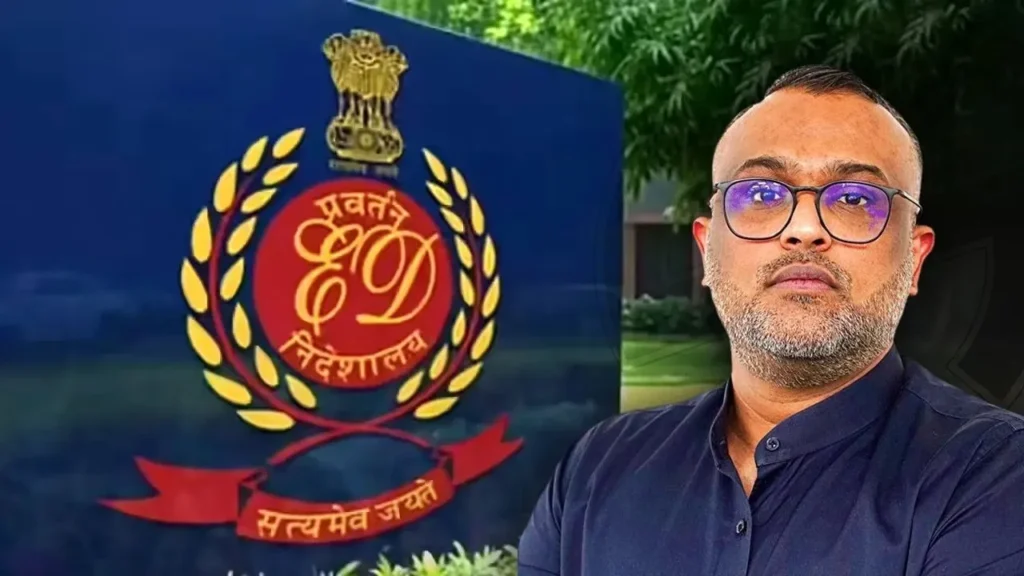
The Indian Political Action Committee (I-PAC) has established itself as one of India’s most influential political consultancies, specialising in data-driven strategies, grassroots mobilization, and large-scale election management. In 2026, however, the firm and its leadership came under intense scrutiny from the Enforcement Directorate (ED) in a money laundering probe linked to an alleged coal smuggling racket in West Bengal.
The Founding of I-PAC
I-PAC traces its origins to Citizens for Accountable Governance (CAG), a group of young professionals founded in 2013. It was formally restructured and renamed as the Indian Political Action Committee (I-PAC) in 2015.
Prashant Kishor, the well-known election strategist who later founded the Jan Suraaj Party, is widely recognized as the founder and driving force behind I-PAC. He played a pivotal role in mentoring and shaping the organization’s data-backed, grassroots-oriented approach to political campaigns. Under his guidance, I-PAC gained prominence by working on major election strategies across parties.
However, Prashant Kishor officially stepped away from I-PAC around 2021 to pursue his own political ambitions. He holds no formal directorship or equity stake in the company today. Operational leadership transitioned to the three co-founders and directors who continue to run the firm:
- Pratik Jain (IIT Bombay alumnus): Co-Founder and Director, often regarded as the public face handling strategic operations, especially in West Bengal.
- Vinesh Chandel (National Law Institute University, Bhopal graduate): Co-Founder and Director with a significant stake.
- Rishi Raj Singh (IIT Kanpur alumnus): Co-Founder and Director.
The trio built I-PAC into a professional platform that has managed campaigns for parties, including the Trinamool Congress (TMC) in West Bengal.
January 2026: ED Raids at Pratik Jain’s Office in Salt Lake, Kolkata
On January 8, the Enforcement Directorate conducted searches at Pratik Jain’s residence on Loudon Street and the I-PAC office in Salt Lake Sector V, Kolkata. The raids were part of a money laundering probe linked to an alleged coal smuggling racket in West Bengal, with connections to an older CBI case involving illegal mining and the transportation of coal from West Bengal and Jharkhand.
The operation sparked immediate political controversy. West Bengal Chief Minister Mamata Banerjee visited Jain’s residence and backed him, while TMC leaders alleged that the raids were aimed at seizing party-related data ahead of elections. I-PAC resumed operations at the Salt Lake office shortly after, describing the events as unsettling. Jain’s family even filed a police complaint alleging theft of documents during the raid.
These developments put the spotlight on I-PAC’s proximity to TMC and raised questions about the intersection of political consultancy and ongoing investigations into proceeds of crime.
April 2026: Arrest of Vinesh Chandel and Swift Bail
On April 2, 2026, ED searched multiple premises linked to I-PAC leaders across Delhi, Bengaluru, Hyderabad, and Mumbai. On April 13, 2026, the agency arrested Vinesh Chandel in Delhi. He was remanded to ED custody and later judicial custody. The timing, just days before the West Bengal Assembly elections, triggered sharp reactions from TMC leaders, who alleged political motives and threats to a level playing field.
However, the legal process moved quickly after polling concluded on April 29. On April 30, 2026, a Delhi court at Patiala House granted bail to Vinesh Chandel on a bond of ₹2 lakh. Notably, the Enforcement Directorate did not oppose the bail, citing his cooperation with the investigation. The court observed that the stringent conditions under PMLA Section 45 were not triggered due to ED’s stand.
What Happened to the I-PAC Team After the Arrest?
Following Vinesh Chandel’s arrest, I-PAC faced significant operational disruption in West Bengal. Around April 18-19, 2026, the firm’s HR department reportedly sent an internal email to Bengal-based employees, asking them to avail of a 20-day leave and temporarily pause operations in the state, citing “certain legal issues.” Staff were instructed to regroup and review the situation by May 11, 2026.
Reports indicated that several verticals shifted to a work-from-home model, with restrictions on the use of official email IDs for stakeholder communication. Some teams were reportedly moved or scaled down, and the firm maintained a low public profile. TMC, however, strongly denied any major disruption, calling reports of a shutdown “baseless” and asserting that I-PAC’s West Bengal unit continued supporting campaign activities as planned.
The developments created uncertainty among the on-the-ground team, with reduced visibility and concerns about further legal summons (including to Pratik Jain’s family members). While the Salt Lake office had resumed operations after the January raids, the April events prompted a more cautious operational reset during the sensitive election period.