


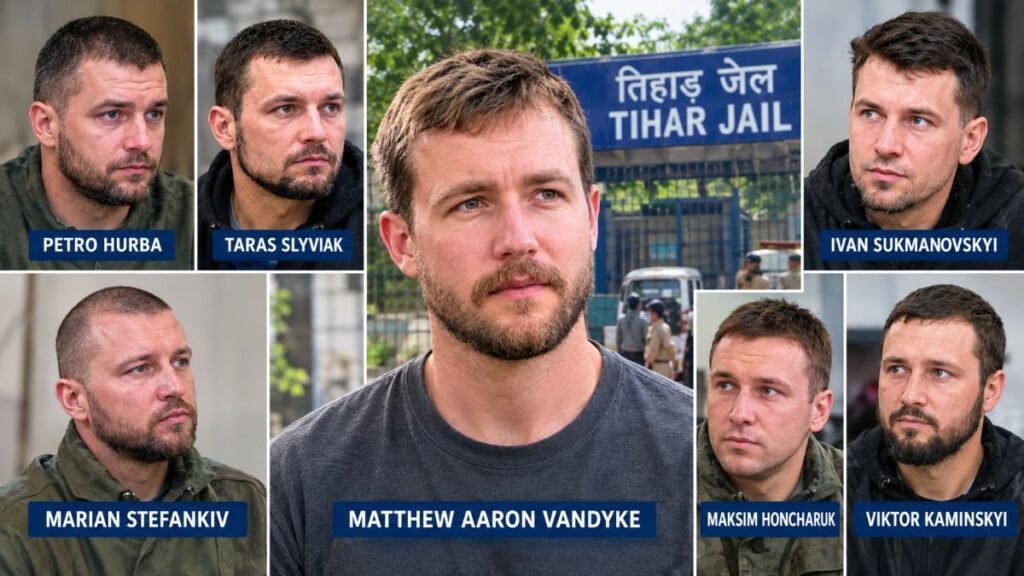
In March 2026, India’s National Investigation Agency (NIA) arrested U.S. national Matthew Aaron VanDyke and six Ukrainian nationals in connection with alleged activities involving ethnic armed groups in Myanmar. The group was initially booked under anti-terror provisions, but the case evolved significantly. By late September 2026, all seven received default bail after the NIA filed a chargesheet limited to immigration violations. A Delhi court then permitted them to travel home for a month, and they were released from Tihar Jail.
The Arrests
On March 13, 2026, the NIA arrested the seven foreign nationals at different airports while they were attempting to leave India:
- Matthew Aaron VanDyke (U.S. citizen) was arrested at Kolkata airport.
- Three Ukrainians: Petro Hurba, Taras Slyviak, and Ivan Sukmanovskyi, were arrested at Lucknow airport.
- The remaining three: Marian Stefankiv, Maksim (or Maksym) Honcharuk, and Viktor Kaminskyi,were arrested at Delhi airport.
The NIA initially registered the case under Section 18 of the Unlawful Activities (Prevention) Act (UAPA), which covers conspiracy, attempt, advocacy, abetment, or facilitation of a terrorist act, along with other provisions. Investigators alleged that the group had entered India on tourist visas in December 2025, travelled to Guwahati and Mizoram without the required Protected Area Permit or Restricted Area Permit, and then crossed into Myanmar through unauthorised border points.
According to the NIA, they reached a location referred to as Victoria Camp in Myanmar to conduct pre-scheduled training for ethnic armed groups (including the Chin National Front and Kachin Independence Army) in drone warfare, drone operations, assembly, and jamming technology. The agency claimed these groups have links that could affect India’s security interests, including possible assistance to Indian insurgent outfits. Some reports also referenced alleged involvement in a drone-related incident in Myanmar. The seven were lodged in judicial custody at Tihar Jail in Delhi.
Investigation and Chargesheet
The NIA sought and received custodial interrogation periods early in the case. Investigators examined digital devices, travel patterns, and possible wider networks. VanDyke, a former journalist and filmmaker known for covering conflict zones and later associated with activities in Ukraine, was described in some accounts as having played a coordinating role.
On September 8, 2026, the NIA filed its chargesheet. Crucially, it invoked only Sections 21 and 23 of the Immigration and Foreigners Act, 2025 (relating to illegal entry, stay, and movement in violation of visa conditions). It did not charge the accused under UAPA at that stage, even though the agency stated that further investigation into possible UAPA offences remained ongoing. The court later described the chargesheet as “piecemeal.”
The immigration offences were compounded (settled) by payment of fines of ₹5.5 lakh each to the Foreigners Regional Registration Office (FRRO).
Default Bail and Release from Tihar
Because the NIA did not complete a full chargesheet covering the more serious allegations within the statutory time limit while the accused remained in custody, the court granted default bail:
- VanDyke received default bail around September 18, 2026 (on a personal bond and surety of ₹1 lakh each).
- The six Ukrainian nationals received default bail on September 23, 2026 (similar personal bonds and cash deposits of ₹1 lakh each).
On September 24, 2026, Special NIA Judge Prashant Sharma of Delhi’s Rouse Avenue Courts allowed applications from all seven to travel abroad for one month to meet their families (they had sought six weeks). The court ordered the release of their passports, directed them to return after one month (calculated from the date of departure), to inform the authorities within 72 hours of return, to provide contact details, and to cooperate with any further investigation (including via video conferencing if required). The NIA did not strongly oppose the travel permission, noting that their immediate physical presence was not required.
VanDyke and at least one of the Ukrainians were released from Tihar Jail on the evening of September 24, 2026. Visuals circulated of VanDyke leaving the jail. Reports indicated VanDyke planned to travel to the U.S. (with a return flight booked around October 21), while the Ukrainians were permitted to go to Ukraine.
Current Status
The immigration charges have been addressed through compounding and default bail. However, the NIA has kept the broader probe open, stating that analysis of digital evidence and other material could still indicate involvement in activities affecting India’s security. No final determination on UAPA charges has been publicly closed.
The case has drawn political commentary in India, with some opposition voices questioning the handling of the matter and the decision to allow travel while aspects of the investigation continue.