


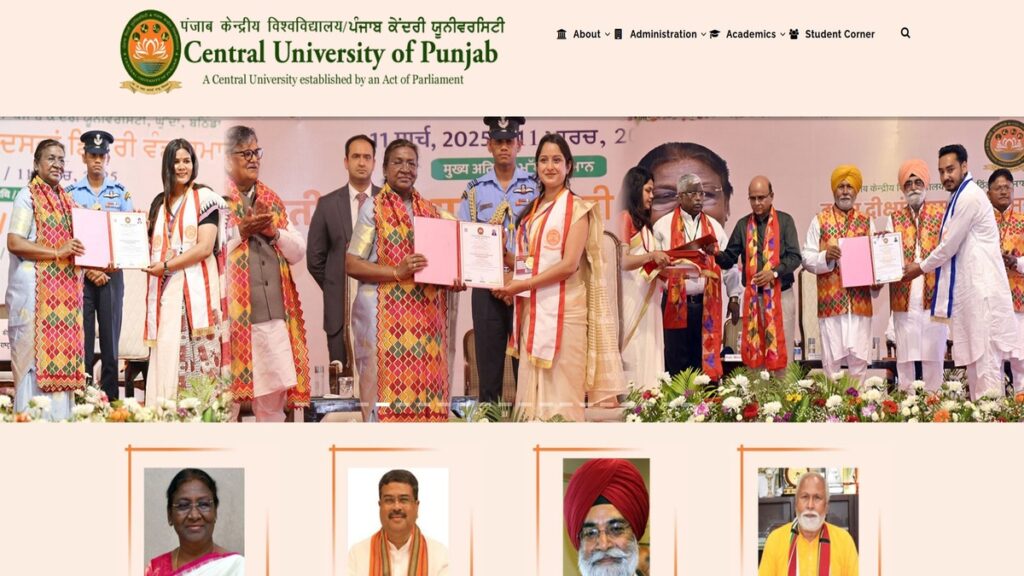
The Central University of Punjab (CUP), established in 2009 through an Act of Parliament, stands as a beacon of higher education in the state of Punjab. Located in the village of Ghudda, Bathinda, on a sprawling 500-acre green campus designed to be energy-efficient and environment-friendly, CUP has rapidly ascended the ranks of India’s academic institutions. It boasts impressive accolades, including a consistent top-100 ranking in the NIRF University category for seven consecutive years (2019-2025), an NAAC A+ grade, and a position in the 601-800 band in the Times Higher Education World University Rankings 2026. The university is also ISO 9001:2015 and ISO 14001:2015 certified, emphasizing its commitment to quality and environmental management.
With 31 departments under 11 schools, it offers a diverse range of programs across sciences, technology, humanities, law, and social sciences. The institution has implemented the National Education Policy 2020 since the 2021-22 session, promoting interdisciplinary studies and skill development. Its research prowess is evident from metrics like an h-index of 114 (Scopus) and over 108,000 citations, alongside 229 extramural research grants. The university’s multicultural fabric draws students from 28 states, 7 union territories, and international backgrounds, supported by highly qualified faculty with international experience.
As we approach the end of 2025, CUP is inviting applications for its PhD programs (both regular and part-time) for the Academic Session 2025-26, specifically the January 2026 intake. T
Important Dates and Application Process
The admission cycle kicked off with the release of the advertisement and opening of the online portal on December 16, 2025 (Tuesday). Eligible candidates must submit their applications by January 6, 2026 (Tuesday). Interviews are scheduled for January 23, 2026 (Friday), with results, commencement of coursework, and final admission/registration dates to be notified later on the university website.
Applications are accepted exclusively online via the CUP website (www.cup.edu.in). Navigate to the admissions page, review the eligibility criteria, and complete the form. Candidates bear sole responsibility for ensuring they meet the requirements. The prospectus is informational and subject to updates on the website.
Application Fees
The online application fee, payable via UPI, debit, or credit card, is as follows:
- General/OBC candidates: Rs. 1,000
- SC/ST candidates: Rs. 500
- PWD candidates: No fee
Eligibility Criteria
For regular PhD programs, applicants must hold a Master’s degree in the relevant field with a minimum of 55% marks (50% for SC/ST/OBC(NCL)/PWD candidates) from a recognized Indian or foreign university. Specific eligibility varies by program, as detailed in the programs list below.
Pursuant to UGC regulations dated March 27, 2024, the National Eligibility Test (NET) score replaces university-conducted entrance tests. NET-qualified candidates are categorized as:
- Category-1: Eligible for PhD admission with JRF and Assistant Professor appointment.
- Category-2: Eligible for PhD without JRF and Assistant Professor appointment.
- Category-3: Eligible for PhD admission only (no JRF or Assistant Professor appointment).
Validity for Categories 2 and 3 aligns with UGC guidelines, and pre-March 27, 2024 NET qualifiers remain eligible.
For part-time PhD, additional guidelines apply per UGC Regulations 2022:
- Employed candidates need a No Objection Certificate (NOC) from their employer, confirming permission for part-time study, sufficient research time, and potential relief for coursework.
- No fellowships/assistantships are available for part-time mode.
- Eligibility, duration, admission procedure, supervisor allocation, and coursework mirror regular PhD, with coursework (12-16 credits) possible in physical or hybrid mode (up to 40% online via SWAYAM/MOOCs).
Selection Criteria
Admission leverages NET scores for initial eligibility, followed by an interview. If applications exceed expectations, stringent shortlisting criteria may apply. The university reserves the right to adjust seat numbers or not offer a program if response is inadequate. Reservations follow Government of India/University rules.
The medium of instruction is English/Hindi (except language programs), and admitted students must submit a medical fitness certificate from a government hospital or university health center.
Schools, Departments, and Seat Availability
CUP offers PhD in 39 programs across 11 schools, with a total of 206 seats. Below is a comprehensive table summarizing the programs, eligibility, areas of specialization, and seats. Note that seats may change, with updates on the website.
| School | Department | Program | Eligibility Criteria | Area of Specialization | No. of Seats |
|---|---|---|---|---|---|
| School of Basic Sciences | Department of Chemistry | Chemistry | Master’s degree in Chemistry (Inorganic/Organic/Physical/Analytical/Bio-inorganic/Bio-Physical/Medicinal/Applied/Pharmaceutical) and Biochemistry, Biotechnology, Biophysics with min. 55% marks (50% for reserved). | Organic and Medicinal Chemistry, Green Chemistry, Organic Synthesis, Catalysis, Neurological disorders, Bio-inorganic and Biophysical Chemistry, Biotechnology, Physical and Nanomaterial, Inorganic chemistry, Nanocluster. | 17 |
| School of Basic Sciences | Department of Computational Sciences | Bioinformatics | Master’s degree in Bioinformatics/Life Sciences/Biotechnology/Physics/Chemistry or relevant areas with min. 55% marks (50% for reserved). | Bioinformatics (Structural Biology, Structural Bioinformatics, Molecular Modelling, Genomics, Transcriptomics). | 5 |
| School of Basic Sciences | Department of Computational Sciences | Theoretical and Computational Chemistry | Master’s degree in Chemistry or relevant areas with min. 55% marks (50% for reserved). | Theoretical and Computational Chemistry. | 2 |
| School of Basic Sciences | Department of Computational Sciences | Computational Physics | Master’s degree in Physics or relevant areas with min. 55% marks (50% for reserved). | Computational Physics (Computational Condensed Matter Physics). | 3 |
| School of Basic Sciences | Department of Mathematics and Statistics | Mathematics | Master’s degree in Mathematics with min. 55% marks (50% for reserved). | Cryptography, Image Security, Riemann-Finsler Geometry, Homogeneous Finsler Spaces, Nonlinear Partial Differential Equations (PDEs), Fractional Differential Equations, Applied Probability, Statistics, Actuarial Statistics, Statistical Modeling. | 6 |
| School of Basic Sciences | Department of Mathematics and Statistics | Statistics | Master’s degree in Statistics with min. 55% marks (50% for reserved). | Applied Probability, Statistics, Actuarial Statistics, Statistical Modeling, Inferential Statistics, Biostatistics. | 2 |
| School of Basic Sciences | Department of Physics | Physics | Master’s degree in Physics/Applied Physics with min. 55% marks (50% for reserved). | Nanotechnology and Advanced Materials for energy applications, Meta-Materials, Advanced Materials, Nanomaterials for Renewable Energy Applications, Experimental Condensed Matter Physics, Advanced Laser Spectroscopy, Computational Materials Physics, Accelerator & Plasma, Supercapacitors & Solar Cells. | 24 |
| School of Basic Sciences | Department of Botany | Botany | Master’s degree in Botany, Plant Sciences and allied subjects in Life Sciences with min. 55% marks (50% for reserved). | Genetics and Genomics; Plant Genetic and Metabolic Engineering, Marine Biology, Plant Taxonomy. | 3 |
| School of Basic Sciences | Department of Zoology | Zoology | Master’s degree in any branch of Life Sciences/Veterinary Sciences with min. 55% marks (50% for reserved). | Neurobiology/Medical Genetics/Applied Zoology, cancer biology, non-coding RNA, Neurodegenerative Alzheimer’s disease, Taxonomy and Ecology of soil Nematodes and Impact of heavy metals on soil nematodes, Nematology and earthworm biology, Cardiovascular diseases and Lung cancer, Neuroscience, Endocrinology and interest in molecular biology. | 5 |
| School of Basic Sciences | Department of Biochemistry | Biochemistry | Master’s degree in Life Sciences or related area with min. 55% marks (50% for reserved). | Biochemistry. | 5 |
| School of Basic Sciences | Department of Microbiology | Microbiology | Master’s degree in Life Sciences or allied subjects with min. 55% marks (50% for reserved). | Microbiology and allied Sciences. | 6 |
| School of Basic Sciences | Department of Applied Agriculture | Agribusiness | MBA (Agribusiness)/Master’s Degree in Agricultural Marketing with min. 55% marks (50% for reserved). | Agribusiness Management. | 4 |
| School of Basic Sciences | Department of Applied Agriculture | Food Science & Technology | Master’s Degree in food science and allied fields with min. 55% marks (50% for reserved). | Food Science & Technology. | 3 |
| School of Education | Department of Physical Education | Physical Education | Master’s degree in Physical Education or Physical Education & Sports or Sports Sciences with min. 55% marks (50% for reserved). | Physical Education. | 1 |
| School of Education | Department of Education | Education | Master’s degree in Education with min. 55% marks (50% for reserved). | Educational Technology, Advanced Educational psychology, Inclusive Education, Special Education, Women Education, Educational Management and Leadership, Sustainable development, Curriculum design and development, ICT mediated pedagogies, Elementary Education and Science Education. | 3 |
| School of Engineering and Technology | Department of Computer Science and Technology | Computer Science & Technology | Master of Engineering in Computer Engineering, Computer Science & Technology, Information Technology or equivalent with min. 55% marks or 6 CGPA (50% or 5.5 for reserved); or M.Sc. (CS/IT) with min. 75% (70% for reserved); or MCA with min. 75% (70% for reserved). | Artificial Intelligence and computer vision, DDoS attacks detection, Deep Learning, Multimodal Sentiment Analysis, Natural Language Processing, Web Content Mining, Data Analytics, Large Language Models, Cyber Security, Machine Learning. | 12 |
| School of Environment and Earth Sciences | Department of Environmental Science and Technology | Environmental Sciences | Master’s degree in Environmental Sciences/Environmental Engineering/Environment Science & Technology/Biotechnology/Botany/Chemistry/Civil Engineering with specialization in Environment/Energy & Environment with min. 55% marks (50% for reserved). | Environmental pollution monitoring and abatement, Solid Waste Management, Radio-ecology, Development of bio-herbicides, bio-sensors, Resource recovery and Circular economy, Environmental nanotechnology, Bioenergy, Eco-friendly products-Bioplastics, Bioremediation, Environmental Geochemistry, Atmospheric and aerosol chemistry, Remote Sensing and GIS for Environmental application and Climate Change. | 9 |
| School of Environment and Earth Sciences | Department of Geology | Geology | Master’s degree in Geology/Earth Science/Geological Science/Applied Geology/Marine Geology/Environmental Science/Physics/Chemistry/Allied Subjects with min. 55% marks (50% for reserved). | Geochemistry, Hydrogeology, Paleontology, Ore geology, Paleomagnetism, Metamorphic petrology, Igneous petrology. | 15 |
| School of Environment and Earth Sciences | Department of Geography | Geography | Master’s degree in Geography/Urban Planning/Geo-informatics/Population studies with min. 55% marks (50% for reserved). | Population Geography, Health Geography, Natural Resource, Disaster Studies, Rural and Urban Studies, Geoinformatics. | 7 |
| School of Health Sciences | Department of Human Genetics and Molecular Medicine | Human Genetics | Master’s degree in any branch of Life Sciences with min. 55% marks (50% for reserved). | Human Genetics. | 2 |
| School of Health Sciences | Department of Human Genetics and Molecular Medicine | Molecular Medicine | Master’s degree in any branch of Life Sciences with min. 55% marks (50% for reserved). | Molecular Medicine. | 4 |
| School of Health Sciences | Department of Pharmaceutical Sciences and Natural Products | Medicinal Chemistry | Master’s degree in M.Pharm./M.S.(Pharm.)/M.Sc. or equivalent in Medicinal Chemistry/Pharmaceutical Chemistry/Chemistry with min. 55% marks (50% for reserved). | Medicinal Chemistry, Pharmaceutical Chemistry/Pharmacognosy/Natural Products/Chemistry/Medicinal Chemistry/Pharmaceutical Analysis. | 4 |
| School of Health Sciences | Department of Pharmacology | Pharmacology | B.Pharm/B.Sc. in Life Sciences (4-year) and Master’s in M.Pharm/M.S.(Pharm) or equivalent in Pharmaceutical Sciences/Pharmacology with min. 60% marks (55% for reserved). | Pharmacology. | 5 |
| School of Information and Communication Studies | Department of Mass Communication & Media Studies | Mass Communication & Media Studies | Master’s degree in Journalism and Mass Communication with min. 55% marks (50% for reserved). | Social Media, Misinformation, Health Communication, Films and Advertising. | 6 |
| School of Information and Communication Studies | Department of Library and Information Sciences | Library and Information Science | Master’s degree in Library and Information Sciences with min. 55% marks (50% for reserved). | Altmetrics, Informetrics, Information Retrieval, Scholarly Communication; Information Seeking behavior, Information Literacy, Rural Development and Women Studies, Indigenous Knowledge. | 2 |
| School of International Studies | Department of South and Central Asian Studies | Politics and IR | M.A. in Political Science, Politics and International Relations, etc., with min. 55% marks (50% for reserved). | Geopolitics of South & Central Asia. | 1 |
| School of International Studies | Department of South and Central Asian Studies | Political Science | Master’s degree in Political Science & allied subjects with min. 55% marks (50% for reserved). | Indian foreign policy, geopolitics, Russia and Central Asia, climate change politics. | 2 |
| School of Languages, Literature and Culture | Department of English | English | Master’s degree in English/Linguistics with min. 55% marks (50% for reserved). | Language Studies/Media Studies/Stylistics; Theories of Subjectivity/Indian Drama/Indian Cinema. | 3 |
| School of Languages, Literature and Culture | Department of Punjabi | Punjabi | Master’s degree in Punjabi with min. 55% marks (50% for reserved). | Modern Punjabi Poetry, Medieval Punjabi Literature, Gurbani Studies, Punjabi Language and Linguistics. | 4 |
| School of Languages, Literature and Culture | Department of Hindi | Hindi | Master’s degree in Hindi with min. 55% marks (50% for reserved). | Hindi Fiction. | 2 |
| School of Languages, Literature and Culture | Department of Performing and Fine Arts | Performing Arts-Theatre/Drama | Master’s degree in Performing Arts-Theater/Drama with min. 55% marks (50% for reserved). | – | 2 |
| School of Languages, Literature and Culture | Department of Performing and Fine Arts | Music | Master’s degree in Music with min. 55% marks (50% for reserved). | Music, Music Therapy, Interdisciplinary approach with Allied Subjects. | 2 |
| School of Legal Studies | Department of Law | Law | Master’s degree in Law with min. 55% marks (50% for reserved). | Law. | 2 |
| School of Management | Department of Financial Administration | Commerce | Master’s degree in Commerce/Finance/Management/Allied Subjects with min. 55% marks (50% for reserved). | Finance, Marketing, and HRM. | 7 |
| School of Social Sciences | Department of Economic Studies | Economics | Master’s degree in Economics with min. 55% marks (50% for reserved). | Agricultural Economics, Development Economics, Agriculture Climate change and migration. | 10 |
| School of Social Sciences | Department of Sociology | Sociology | Master’s degree in Sociology, Development Studies, etc., with min. 55% marks (50% for reserved). | Sociology of health and illnesses, human rights, Diaspora studies, Development studies, Tribal studies, sociology of religion. | 10 |
| School of Social Sciences | Department of History | History | Master’s degree in History with min. 55% marks (50% for reserved). | Modern India. | 4 |
| School of Social Sciences | Department of Psychology | Psychology | Master’s degree in Psychology/Applied Psychology with min. 55% marks (50% for reserved). | Educational psychology, Health Psychology, Cognitive Psychology, Positive Psychology, Rehabilitational Psychology, Mental Health, Cyber Psychology. | 2 |
Total Seats: 206
Link: Click Here
Prospectus: Click Here
Advertisement in English: Click Here