Vikshit Bharat Must Be Accessible Bharat :Why Disability Inclusion Is Not Welfare — It Is Nation Building
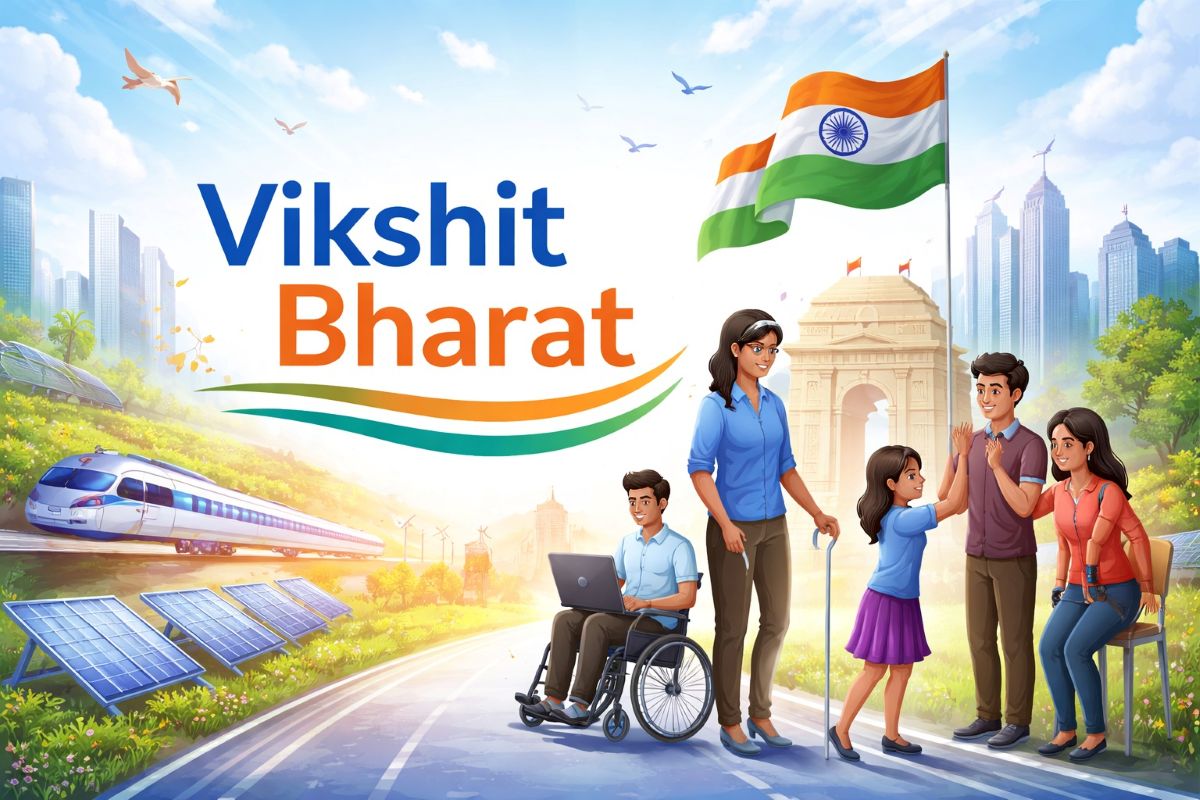
India is moving with ambition toward Vikshit Bharat 2047.
We speak of becoming a $5 trillion economy. We celebrate digital transformation. We build highways, smart cities, and industrial corridors.
But there is a fundamental question we must ask:
Can a country truly be called developed if accessibility remains optional?
Development cannot be measured only in GDP, infrastructure, or digital transactions. It must also be measured in dignity.
A developed India must ensure that a Person with Disability can independently:
- Live
- Learn
- Work
- Lead
Anything less is incomplete progress.
A Personal Reflection: When Innovation Became Inclusion
Years ago, as a student, I experienced something small but transformative.
After long hours of studying, flipping pages became tiring. It was a minor inconvenience. But that moment triggered a bigger question:
What about someone who does not have the use of their upper limbs at all? What about a student who wants to read independently but physically cannot turn a page?
That thought led me to develop a foot-operated manual page-turning machine, designed to empower individuals with upper-limb impairments to read independently and with dignity.
The recognition that followed was encouraging. But what stayed with me most was not the acknowledgment — it was the realization that barriers are often not natural; they are designed into systems.
And if barriers are designed, they can be redesigned.
That is where policy enters the conversation.
Disability Inclusion Is Not Charity
One of the most limiting frameworks in public discourse is the tendency to treat disability inclusion as welfare.
Inclusion is not about sympathy. It is about structure.
It is:
- An economic growth driver
- A human capital investment
- An innovation catalyst
- A democratic strengthening mechanism
India cannot aspire to demographic dividend while ignoring millions of capable citizens.
We must shift from viewing Persons with Disabilities (PwDs) as beneficiaries — to recognizing them as contributors.
Structural Shifts Required for Vikshit Bharat
If we are serious about becoming a developed nation, inclusion must move from tokenism to design.
Here are six high-impact, scalable interventions India should adopt:
1. Universal Design as a Development Indicator
Accessibility should not be a compliance checkbox.
It should be measurable.
- Universal Design Certification for public infrastructure
- Accessibility ratings for districts
- Mandatory audits for Smart Cities
- Public dashboards tracking compliance
When accessibility becomes measurable, it becomes actionable.
2. Assistive Technology Innovation Mission
India has the engineering talent and frugal innovation capacity to become a global hub for affordable assistive devices.
We need:
- District-level Assistive Technology Labs
- Startup grants for disability-focused innovation
- Open-source design repositories
- Government procurement preference for indigenous assistive tech
Inclusion and Atmanirbhar Bharat can go hand in hand.
3. Inclusive Digital Bharat
Digital transformation without accessibility creates digital exclusion.
All government platforms must be accessible by default:
- Screen reader compatibility
- Voice-enabled portals
- AI-based sign language interpretation
- Mandatory accessibility compliance standards
Digital India must work for all Indians.
4. Inclusive Employment Ecosystems
Employment inclusion must evolve beyond reservation quotas.
We need:
- Skill mapping aligned with industry needs
- Wage incentives for inclusive employers
- Remote work hubs in Tier 2 and Tier 3 cities
- Accessibility-linked ESG certifications
Persons with Disabilities are not liabilities.
They are underutilized productivity.
5. Political Inclusion and Leadership Pipeline
True democracy is not just about voting. It is about representation.
We must ensure:
- 100% accessible polling booths
- Leadership fellowships for aspiring PwD leaders
- Disability charters in political manifestos
- Annual public accountability reports
From policy subjects to policy makers — that is, democratic maturity.
6. Education Without Barriers
Inclusion must begin early.
- Inclusive classroom training for teachers
- Subsidized assistive learning kits
- AI-enabled personalized learning
- Inclusive accreditation rankings for institutions
Early inclusion builds lifelong confidence — and economic participation.
The Real Metric of a Developed Nation
A developed India will not be judged only by expressways or startups.
It will be judged by something far more human:
How independently can a person with disability navigate daily life?
How accessible are public spaces?
How inclusive are workplaces?
How representative is political leadership?
Vikshit Bharat will not be built by infrastructure alone.
It will be built when:
- Accessibility becomes instinct
- Inclusion becomes policy
- Dignity becomes non-negotiable
A Collective Responsibility
Disability inclusion is not the responsibility of any one ministry, NGO, or election manifesto.
It is a cross-sectoral responsibility:
- Policymakers
- Entrepreneurs
- Educators
- Urban planners
- Technologists
- Political leaders
- Civil society
And citizens.
If we want to build a nation that is not only powerful but just, not only wealthy but equitable, then accessibility must move from the margins to the mainstream.
Accessible Bharat is not a slogan.
It is the foundation of Vikshit Bharat.
If you found this perspective valuable, I invite you to share your thoughts:
What is the one reform India must prioritize to make inclusion irreversible?
Let’s move this conversation from policy rooms to public discourse.