


If you are planning to buy a flat in Guwahati, you have probably heard the term “RERA-registered project” thrown around by sales executives as if it were a magic shield that protects you from every possible problem.
In theory, it is. In reality, many buyers are discovering that registration alone is not enough.
First, What Exactly is RERA?
RERA stands for Real Estate (Regulation and Development) Act, 2016 – a central law that came into force on 1 May 2017. Every state has its own RERA authority (in our case, the Assam Real Estate Regulatory Authority or Assam RERA).
The main promises of RERA are simple:
- Every new project (launched after May 2017, or ongoing projects with unsold inventory) must be registered with the state RERA before a single brochure can be printed or a single rupee collected.
- 70% of the money buyers pay must go into a separate project-specific escrow account and can be used only for construction of that particular project.
- Builders have to upload quarterly progress reports (photos, financials, completion status) on the RERA portal.
- After the occupancy certificate is issued, the builder has to help form an Association of Allottees (residents’ society) within three months.
- All advertisements must carry the unique RERA registration number.
- Delays attract automatic interest payment to buyers (currently SBI MCLR + 2%).
On paper, it is one of the strongest consumer-protection laws in the country. On the ground in Guwahati, the story is different.
The Reality Check in 2025
A senior official of Assam RERA recently admitted to GPlus that the single biggest violation in the state is non-submission of mandatory quarterly progress reports. Without these updates, buyers have no way of knowing whether their hard-earned money is actually being used to pour concrete or is being diverted elsewhere.
Another widespread complaint: builders refusing to form residents’ associations even years after handing over possession. Without a registered society, flat owners cannot legally take over common areas, raise maintenance issues, or even approach the RERA tribunal collectively.
Then there is the old trick of diverting funds. Despite the 70% escrow rule being crystal clear, some developers still route buyer money into personal or sister-company accounts. Several such cases are currently pending before the Assam RERA adjudication bench.
Advertising violations are equally common. Walk into any real-estate expo in Guwahati and you will still see glossy hoardings and newspaper inserts that proudly talk about “luxury living” but conveniently forget to mention the RERA registration number – a violation that can attract a penalty of up to 5% of the project cost.
When RERA Does Bite
To be fair, Assam RERA has shown teeth on a few occasions:
- A prominent Guwahati developer was slapped with a ₹20-lakh penalty for selling 252 apartments without registering the project.
- In another landmark order, the authority clarified that projects that received occupancy certificates before 2016 are exempt from registration, clearing confusion for thousands of old buildings.
Yet buyers say these are isolated victories. The gap between law and enforcement remains wide.
What Should You Do Before Signing the Cheque?
Here’s a quick checklist every Guwahati homebuyer must follow in 2025:
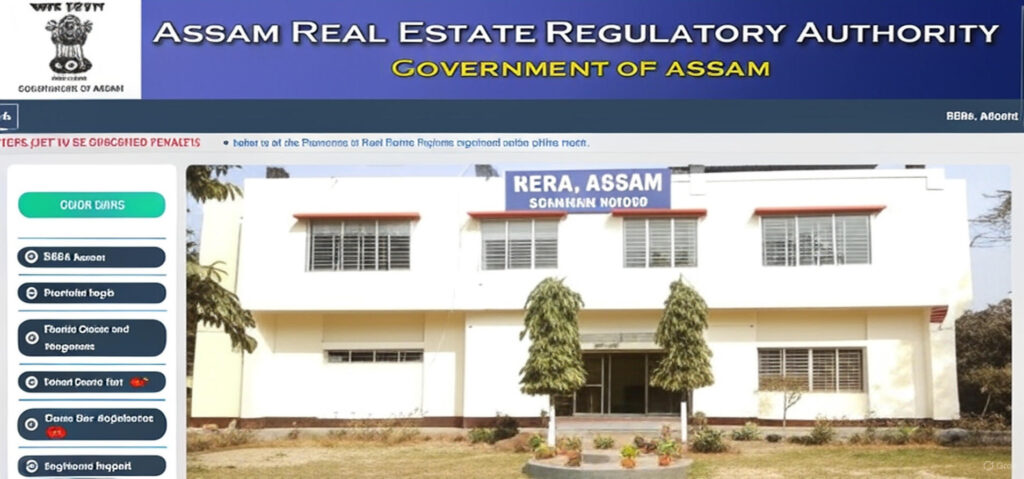
- Visit https://rera.assam.gov.in and search for the exact project name or registration number. If it’s not listed, walk away.
- Download and read the quarterly progress reports. If the last update is more than 4–5 months old, red flag.
- Ask for the escrow account details (bank name, branch, account number). Reputed builders willingly share this.
- Confirm in writing that the builder will initiate formation of the Association of Allottees within three months of OC.
- Never make payments in cash or to personal accounts. Always pay by cheque/RTGS to the project’s designated RERA escrow account.
- File a complaint online on the Assam RERA portal the moment you spot a violation – the authority is surprisingly responsive when complaints are properly documented.
The Bottom Line
RERA was supposed to end the era of vanishing builders and never-ending delays. In Guwahati, it has definitely made life harder for the worst offenders, but it is still not the bullet-proof shield most buyers assume it is.
Until enforcement becomes stricter and awareness deeper, the onus remains on you – the buyer – to treat every “RERA-registered” promise with healthy scepticism and do your own due diligence.
Because in real estate, the only registration that truly protects you is the one you verify yourself.