Understanding the Indian Express Report on the Chief Election Commissioner (CEC)
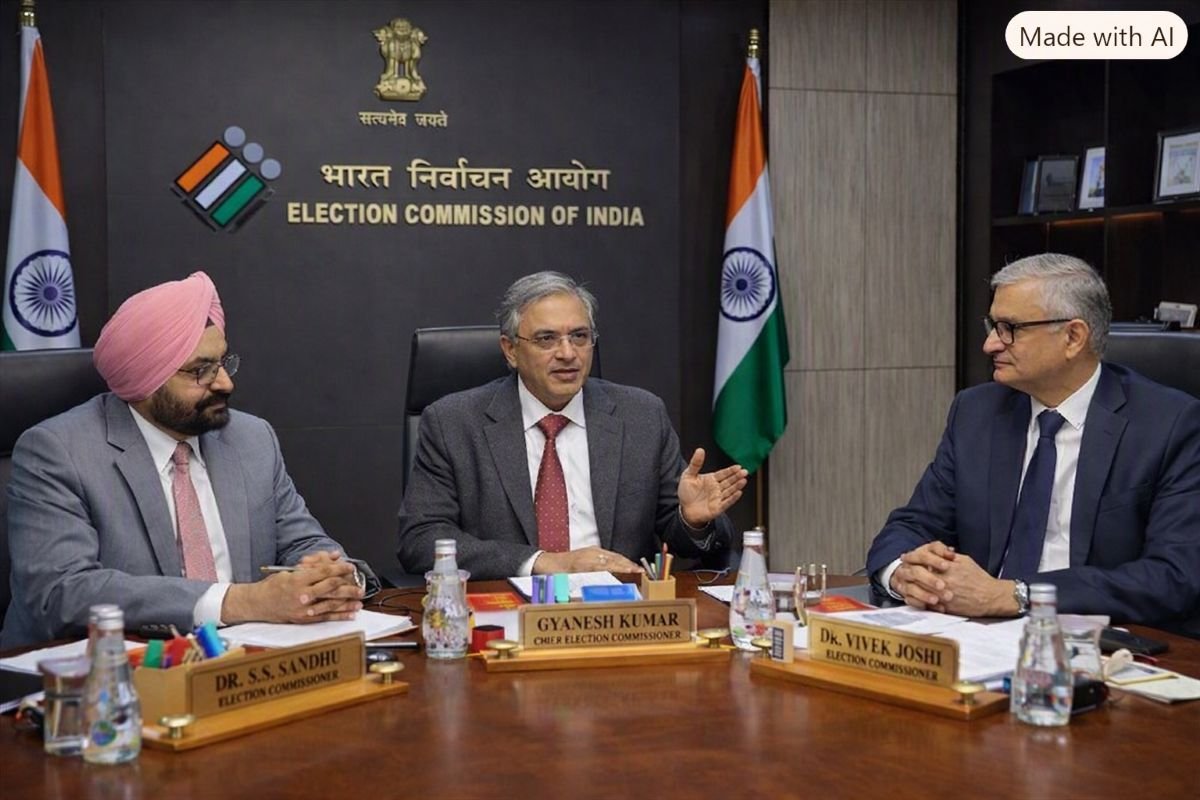
India’s Election Commission (ECI) is a powerful, independent body that conducts free and fair elections. It has three top officers: the Chief Election Commissioner (CEC) and two Election Commissioners. Currently, the CEC is Gyanesh Kumar. The other two are Sukhbir Singh Sandhu and Vivek Joshi.
On 23 September 2026, The Indian Express published a major investigation that created a big political storm. In this blog, I will explain the news in simple language: what happened, why it matters, and the positions of the ruling party (BJP), the Opposition, and the Cockroach Janta Party (CJP).
What Did the Indian Express Investigation Reveal?
The report focused on the Special Intensive Revision (SIR) of electoral rolls. SIR is a process to clean and update the voter lists and removing names of people who have died, moved away, or have duplicate entries, and adding new eligible voters.
According to the investigation:
- Over 10 months (roughly November 2025 to August 2026), the two Election Commissioners (Sandhu and Joshi) formally objected at least 14 times (including four times on a single day) to various decisions and orders issued in the name of the full Election Commission.
- They complained that many decisions were taken without their knowledge.
- Key concerns they raised included:
- Changes to Form 6 (the form used by new voters to register). They called some changes “unauthorised and illegal.”
- How names were being added or deleted from voter lists.
- Centralisation of the voter database in Delhi, which they felt bypassed state-level officials.
- Issues with the security and integrity of the electoral roll software/IT systems.
- In one unusual step, both commissioners even wrote separately to the Cabinet Secretary (a very senior government official) about changes in work allocation that reduced their oversight of the IT systems.
The report said more than 13 crore names had been struck off draft electoral rolls across many states and Union Territories as part of this exercise. The Opposition has long claimed that large-scale voter deletions (especially in states like West Bengal and Bihar) were unfair and favoured the ruling party.
Important note: The Election Commission has not denied that these written objections existed. Instead, it has explained them differently (more on this below).
Why Does This Matter?
In a democracy, the Election Commission must be impartial and appear independent. Decisions are normally taken by the full three-member Commission. If two out of three members repeatedly raise written concerns that major steps are being taken without proper consultation, it raises questions about how the institution is functioning and whether the process is truly collective.
What Is the Opposition’s Stand?
Opposition parties (Congress, Trinamool Congress, Samajwadi Party, AAP, DMK, Shiv Sena UBT, RJD and others) reacted strongly. They shifted their criticism from the Election Commission as a whole to the CEC specifically.
Their main demands and statements include:
- CEC Gyanesh Kumar must resign or be removed immediately. Leaders called him a “dictator,” “Modi’s puppet,” and accused him of “vote chori” (vote theft).
- Rahul Gandhi (Congress) called it “treason” and an attack on the Constitution. He said the BJP, RSS, and EC officials who organised “vote chori” had committed a crime against the Indian people.
- Many leaders demanded a Supreme Court-monitored probe into the Election Commission’s functioning.
- They want the SIR exercise paused or rolled back.
- Some (including Arvind Kejriwal, Mamata Banerjee, and Uddhav Thackeray) called for the CEC’s arrest and even demanded that recent elections be held again with pre-SIR voter lists.
- Opposition parties are preparing a third attempt to move a removal motion in Parliament (the process is similar to impeaching a Supreme Court judge and requires a special majority).
They argue that the written objections prove decisions were not truly unanimous and that the CEC was running the Commission like a one-man show.
What Is the Ruling Party’s (BJP) Stand?
The BJP has strongly defended the Election Commission and the CEC.
- BJP spokesperson Sambit Patra called the internal notes a sign of a “vibrant” and “healthy democracy.” He said that discussions, differing views, and note-taking are normal before final decisions are made.
- The party says the final decisions on SIR and other matters were taken unanimously by the full Commission.
- BJP leaders describe the Opposition’s reaction as a “smear campaign” aimed at discrediting constitutional institutions after electoral losses.
- They maintain that the SIR is a necessary exercise to clean up voter lists and that allegations of manipulation are politically motivated.
In short, the ruling party views the objections as routine internal deliberations, not evidence of wrongdoing.
What Is the Election Commission’s Official Response?
The Election Commission issued a formal statement. Key points:
- Differing views, written notes, technical suggestions, and internal checks are a normal part of decision-making in any institution.
- All final orders and decisions over the past year (including SIR) were the result of unanimous decisions of the full Commission.
- Highlighting only selected internal notes over 10 months shows only “one part of the picture.” The Commission has taken many decisions, issued instructions, and introduced around 40 new initiatives.
- All actions followed the law and established procedures.
- Digital platforms like ECINet have strict data security protocols.
The Commission did not dispute the existence of the 14 notes but framed them as constructive inputs rather than as formal dissent from the final decisions.
What Is the CJP’s Stand?
The Cockroach Janta Party (CJP), led by founder Abhijeet Dipke, has taken a very aggressive public position:
- Dipke called CEC Gyanesh Kumar the “biggest anti-national” and “traitor” in the country and demanded his immediate resignation.
- CJP gave the CEC a 48-hour ultimatum to resign, threatening nationwide protests (sometimes referred to as “Jantar Mantar 2.0”) if it failed.
- They linked the issue to alleged large-scale voter deletions (claiming over 13 crore names removed) and said the electoral process has been “rigged.”
- CJP’s broader demands include:
- Immediate resignation of the CEC and action against those involved in unauthorised decisions.
- Halt to the ongoing SIR and upcoming elections.
- Repeal of the 2023 law that governs the appointment of the CEC and Election Commissioners.
- Dipke has also urged Opposition parties to consider not participating in elections if they believe the process is manipulated, arguing that participation gives legitimacy to a flawed system.
CJP positions itself as fighting to protect the voting rights of ordinary citizens, especially the youth.