Ram Temple Trust Invites Applications for its first CEO
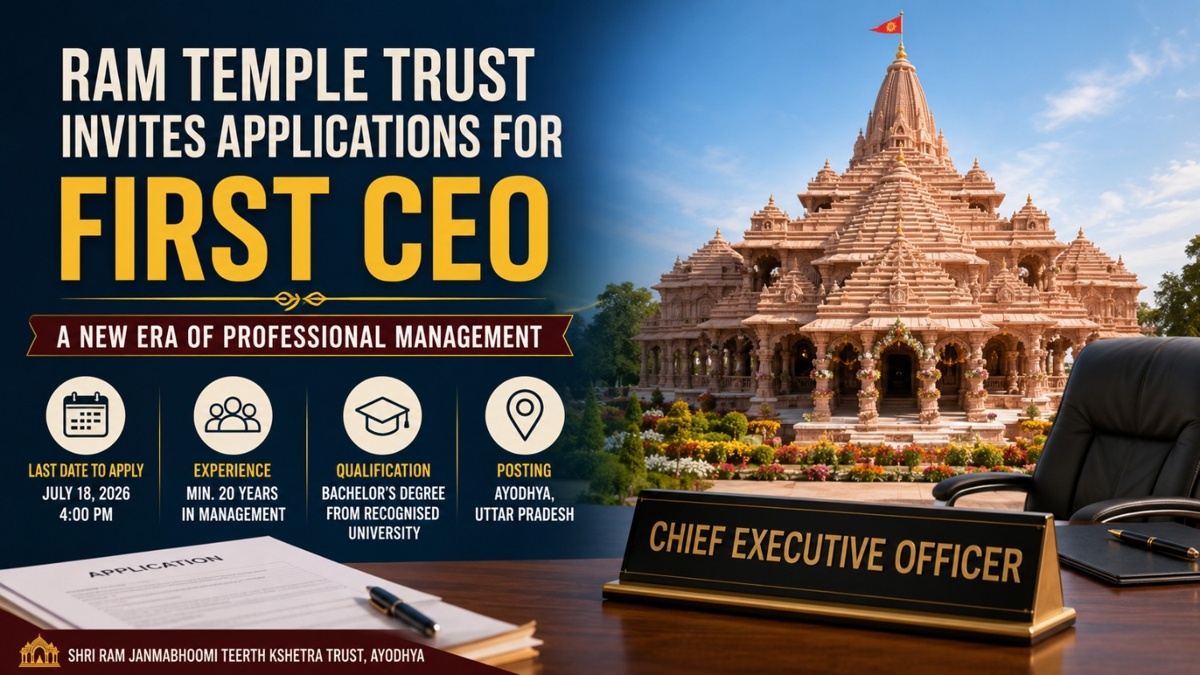
The Shri Ram Janmabhoomi Teerth Kshetra Trust has invited applications for the position of its first Chief Executive Officer (CEO), marking a significant milestone in the administrative evolution of the Ram Temple in Ayodhya. The announcement reflects the Trust’s intention to strengthen governance, financial oversight, and institutional management of one of India’s most important religious institutions.
Historic Appointment for Ram Temple Administration
According to the official notification issued by the Trust, applications for the CEO position will be accepted until July 18, 2026, at 4 PM. The selected candidate will serve on a three-year contractual term, which may be extended based on satisfactory performance.
The decision comes at a crucial time, as the Trust seeks to introduce a more structured administrative framework to manage temple operations, finances, pilgrim services, and future expansion projects.
Eligibility Criteria for the CEO Position
The Trust has laid down stringent eligibility requirements to ensure that only highly experienced professionals are considered.
Educational Qualification
Candidates must possess:
- A Bachelor’s degree from a recognized university.
Age Criteria
Applicants should be between:
- 50 and 70 years of age.
Professional Experience
Candidates must have:
- At least 20 years of managerial experience in a large:
- Public organization
- Government department
- Institution
- Corporate body
Desired Areas of Expertise
The prospective CEO should have experience in multiple administrative domains, including:
- Administration and governance
- Finance and accounting
- Human resource management
- Public relations
- Information technology
- Security management
- Legal affairs
This broad set of requirements indicates that the Trust is seeking a seasoned administrator capable of managing a large and complex institution.
Preference Criteria
The notification states that preference will be given to candidates who:
- Have served as a Chief Administrative Officer (CAO) or equivalent senior administrative role.
- Have prior experience in managing:
- Temples
- Hindu religious institutions
- Large charitable organizations
Additionally, retired government officers who meet the eligibility requirements may apply.
Salary and Benefits
Unlike conventional recruitment advertisements, the Trust has not specified a fixed pay scale.
According to the notification:
- The CEO’s salary and service benefits will be decided through mutual discussion and agreement with the selected candidate.
The posting will be based in Ayodhya, Uttar Pradesh.
Responsibilities of the CEO
Although a detailed job description has not yet been publicly released, the CEO is expected to oversee:
1. Temple Administration
Managing day-to-day operations and ensuring smooth functioning of all departments.
2. Financial Governance
Monitoring donations, expenditures, auditing mechanisms, and ensuring transparency.
3. Pilgrim Management
Coordinating facilities for millions of devotees visiting Ayodhya every year.
4. Infrastructure Development
Supervising future expansion projects, accommodation facilities, and associated civic infrastructure.
5. Technology and Digital Transformation
Implementing digital systems for administration, donor management, crowd monitoring, and communication.
6. Coordination with Government Agencies
Working closely with central and state authorities on security, transport, and urban development initiatives.
Application Deadline
Interested candidates can submit their applications until:
Date: July 18, 2026
Time: 4:00 PM
Applications are being invited by the Shri Ram Janmabhoomi Teerth Kshetra Trust, Ayodhya.
Conclusion
The decision to appoint the first CEO of the Ram Temple is a landmark development in the institutional history of the Shri Ram Janmabhoomi Teerth Kshetra Trust. With millions of devotees expected annually and expanding administrative responsibilities, professional leadership is becoming increasingly essential.